
Helping UK Live Music Survive
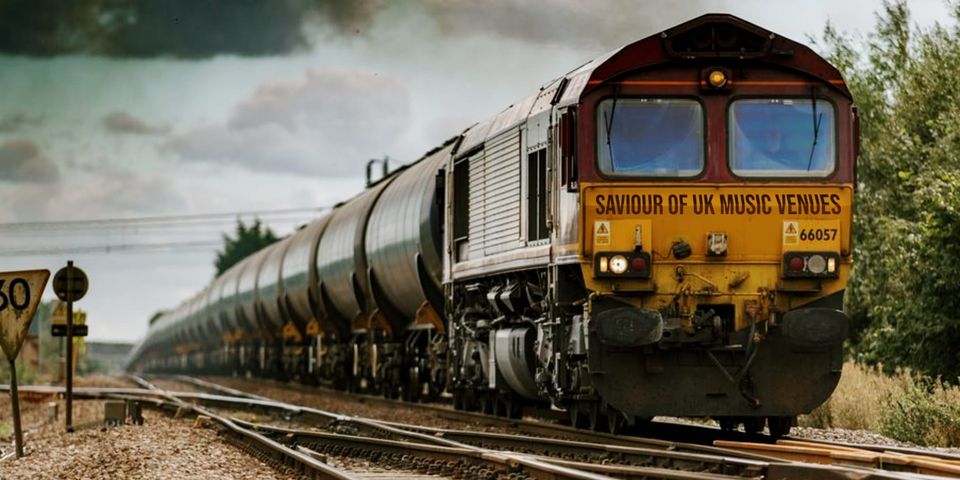
How can trains help rehabilitate the struggling UK grassroots live music scene?
That's an odd question but ok. Perhaps concert tickets could include train travel so journeys to and from venues would be cheaper and also encourage people not to drive. Trains could run later to allow people to stick around until the end of a show and, vitally for the band, still have time to buy merch.
More fancifully: what if overnight freight trains could coordinate with touring bands? A small sleeper carriage for band and crew and space for their gear?
Or: On the Hope Valley line from Manchester to Sheffield, there was once a semi-official 'folk train' every month or so where a folk band would hop on and play music for the passengers. What about embracing this concept more? Opt-in bluetooth broadcasts where each train has a resident live coder hacking out beats that passengers can tune into on their headphones? Or what about hooking up to the train's accelerometer and GPS so electronic musicians can create bespoke, dynamic soundtracks to create a living score of the passing landscape?
So sure: if you ask me how trains can help the UK live music scene, I suppose I can come up with answers, some more realistic than others. But crucially, if you asked me: 'what do you think could help the struggling UK live music scene?', would 'trains' be my answer? Would it be in my top ten answers? No chance. That would be absurd.
OH NO THIS IS A POST ABOUT AI AGAIN ISN'T IT
Yes it is! I trapped you with a classic train-based bait and switch to make the very simple point that how you frame a question affects the answers you get! Which is nevertheless a point that the UK government doesn't seem to be too clued in on!
Last year I mentioned that after doing an interview with some researchers about the UK live music scene, I turned down a further invitation to some kind of retreat being run as part of a large UK arts funding project that was looking at 'how new technology can be used to rehabilitate the struggling UK live music scene'. That's how technology can be used. Not if technology should be used, and not a broader framing of what might help live music? And of course, when they say 'technology', it was very clear after a short back and forth clarifying details that they meant 'AI'.
Last week the final report got released. When they sent me the draft, I initially asked for my quotes to be removed because I disagreed entirely with its general framing of AI-inevitability and the sleight of hand being used to couch everything in an assumption of 'responsible AI' without really being at all clear how or what that means.
After some chat with fellow Team Luddite comrades, I relented and decided that as long as my position was accurately reflected within in the report, perhaps getting them to include some small amount of critical pushback was better than none at all.
The first sentence of the report's executive summary is: "Grassroots Music Venues (GMVs) have complex and far-reaching cultural value: they provide shared social experiences, offer emerging artists their first opportunities, and stimulate local economies." Ok, fine. Makes sense. Here's the second sentence though:
GMVs are uniquely placed to act as live public R&D testbeds for technological innovation, fulfilling a valuable role in future-proofing the sector.
That's right: if the last few decades of UK governance and neoliberalism has taught us anything it is that under no circumstances should any public space where culture happens be simply supported and (scandalous!) maybe even subsidised. No! Why make spaces only for people to come together socially and enjoy music if those spaces could also be made into speculative sites for private investment and A/B testing to help find new ways to subsume art into previously unthought-of commodity shapes and help siphon the precious little profits away from the artists and upwards to a handful of tech companies that would be the ones deemed appropriate to enable this apparent innovation? WHY?!
By the end of the second paragraph: "we are reimagining what live music performance can become in an AI-augmented creative economy."
That didn't take long. Any pretence that the 'technological innovation' mentioned in the second sentence could be anything other than AI is immediately abandoned. Come on! If the innovation REALLY has to be technological then here's some off the top of my head:
- In-house, in-ear monitoring systems for bands to be able to use with their generic in-ear headphones, to help protect the hearing of musicians
- Understage wiring of MIDI routers, USB-over-ethernet systems, working and plentiful XLR stage boxes etc. to help bands who use electronics across the whole stage to not endlessly trip over cables (I have some experience here)
- A high quality screen and projector in every venue that can be tapped into on stage or at the mixing desk or both. With every conceivable adapter/up-scaler box to allow for all varieties of weird DIY visuals bands might be tinkering with
- A decent and regularly maintained selection of amplifiers in every grassroots venue
- Let venues offer multitrack recordings of all shows with additional ambient mics to capture the room and audience, not only the direct mixing desk channels
- RELIABLE AND FAST WI-FI EVERYWHERE IN THE VENUE OH WOW WHAT AN IDEA IMAGINE THAT
- COFFEE MACHINES IN EVERY DRESSING ROOM. COFFEE IS A TECHNOLOGY
I am getting sidetracked and I haven't even got past the second paragraph. The point being even if you believe in technological solutionism to a fault, there is SO MUCH low-hanging fruit here before deciding that AI is somehow the answer.
You know that the cost of the 'arts & humanities' research project this report is a part of is £75.6 million? Here's another sentence from the summary:
Inequity in the system, spoken of by many of our interviewees, also needs to be visibly addressed. Existing business models are predicated on a system that is not sustainable for many...
so far so good! Inequity in the system! How shall we address this?
...and in a future where AI and other emerging technologies may help make more equitable solutions possible.
Ah yes. If there was a single word to sum up the current AI bubble, it is hard to think of a more suitable one than equitable.
Look. I simply do not have the heart to keep going through the entirety of this report. I am no Ed Zitron. I like to keep posts here to a tidy 1000-1500 words and I'm out. So I am going to give myself the last word, because much like the ENTIRE PREMISE OF LARGE LANGUAGE MODEL-BASED-'ARTIFICIAL INTELLIGENCE' EVEN THOUGH IT PRETENDS OTHERWISE, I am in no way objective, but actually entirely biased.
The 'Responsible AI' section ends thusly:
At least one artist we interviewed strongly objected to the use of AI in any context. Paul Wolinski warns that Silicon-valley AI tools foreclose truly creative possibilities: “The use of AI at any level of live music culture can only hollow it out... AI cannot create anything new, only endlessly regurgitate what was made in the past” says Wolinski (Paul Wolinski, keyboard player, 65daysofstatic). He makes the case for “opposing unnecessary technological interventions and pushing back against AI-based tech being injected into grassroots venues” and he warns against widespread “AI boosterism built on hypotheticals about what AI might someday be able to do, somehow ethically, and presumably sustainably.” From this perspective, the irresponsible and unquestioning use of AI could potentially worsen the day-to-day pressures on grassroots music venues, impacting on their struggle for survival, with automation and generative AI leading to the de-skilling of musicians, visual artists and programmers—a future scenario that must be actively resisted.
Was this little fig leaf of an objection worth it? I'm really not sure. It's like the AI Music equivalent of that time the other year when Rishi Sunak announced the treasury to make a 'Britcoin' NFT or whatever it was: arriving years too late to a party that is already over and was awful in every way to begin with.
I guess this is what it looks like when the government places "music and the creative industries at the centre of our economic agenda, as a priority growth sector in our Industrial Strategy."
Not that I remotely agree that it makes any sense to describe music as a 'priority growth sector' but here is a real answer on how to help struggling live grassroots music venues that doesn't have to adhere to a 'technological' solution:
- Subsidise venues so they can afford a proper in-house team of engineers and promoters
- Don't bulldoze every industrial outskirt of a city to make way for yet more luxury flats nobody can afford. Let it stay as warehouses that become studios and rehearsal rooms and art spaces and DIY live music venues
- Arrange and support in-venue mentorships/apprenticeships for sound engineers/lighting engineers and so on
- Give venues the means to support touring bands with accommodation, decent food and where appropriate instruments so the musicians can tour cheaply and more easily
- Fix whatever Brexit shit necessary to make it even slightly worthwhile for international bands to bother coming to play shows in the UK
- Create an environment where more people have access to music and musical instruments AND, crucially, the 'prospective time' to learn them, to be able to think about and make their art, so it isn't only rich kids who can afford to be in bands these days
- Dismantle capitalism ASAP, cheers.
Member discussion